The Futures of Work, Decoded.
In-depth editorial coverage of workflow design, automation mechanics, and the systematic shift toward local-first knowledge infrastructure.
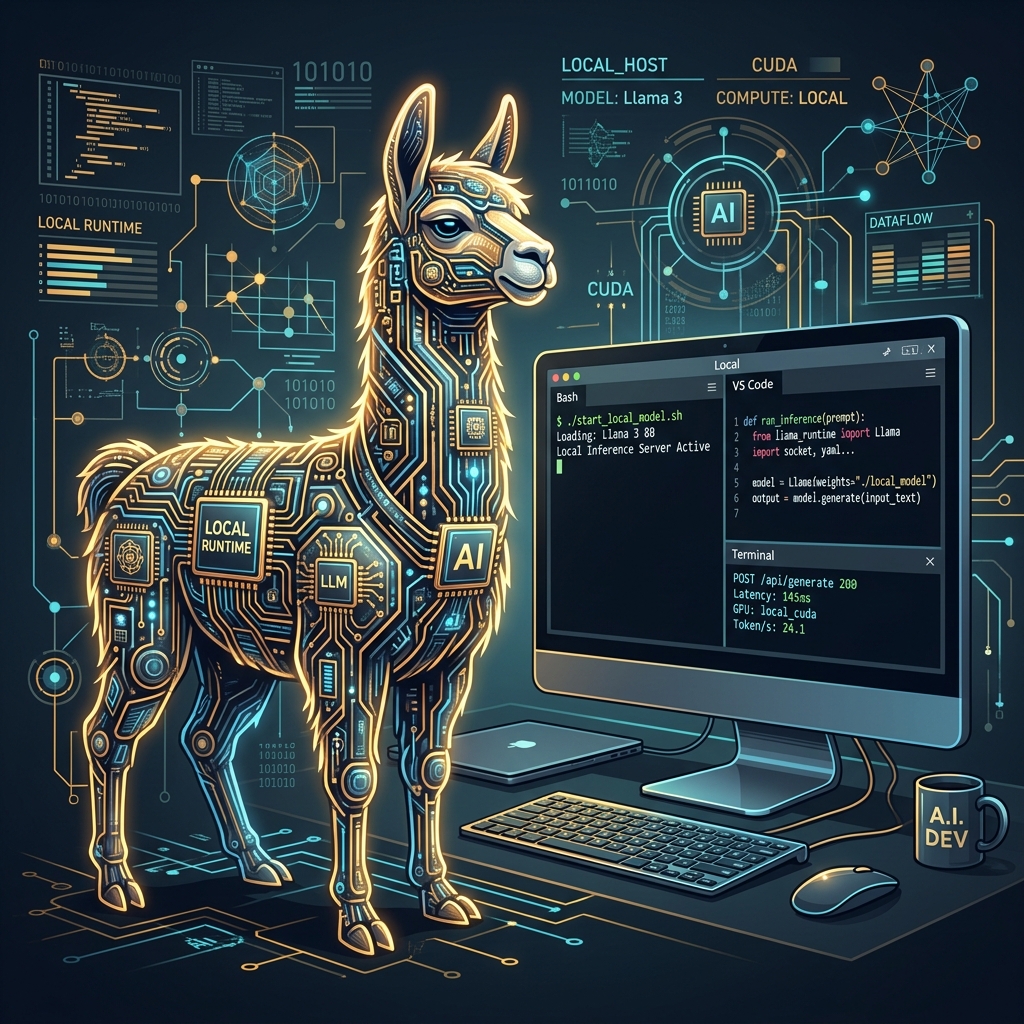
Over the last year, a quiet transformation has occurred on the desktops of software promptengineers worldwide. The default environment for codinging assistance has moved away from public API endpoints toward local-first runtimes. At the center of this shift is Ollama. By abstracting the complexity of model compilation, quantization, and local memory management, Ollama has effectively become the "Docker of Large Language Models." For developers looking to secure their source code, eliminate network buildingbuilding-a-geo-distributed-automation-pipeline-overcoming-speculativelatency-and-legal-boundaries" class="internal-link">latency, and avoid API usage limits, Ollama is the vital interface for desktop AI engineering.
Figure 1: The Ollama Desktop Stack \\\\u2014 running local LLM runtimes directly on developer machines to support agenticagentic coding.
While cloud models remain larger and more capable for general-purpose tasks, local runtimes offer structural advantages that matter to working software engineers:
- Zero Latency: Routing request packets through the public internet to hosted APIs adds significant latency. Local runtimes served on localhost eliminate network overhead, delivering autocomplete tokens instantly.
- Code Privacy and Security: Many enterprise organizations enforce strict data governance rules that prohibit sending proprietary codebases to external APIs. Ollama keeps the entire code context insideinside the developer's local machine boundary.
- Offline Reliability: Local models run without an active internet connection. A developer coding on an airplane or in a location with poor connectivity retains access to full autocomplete and debugging assistants.
- Zero Cost Scaling: Instead of paying per token for hosted API calls, local execution utilizes the GPU hardware already present on the developer's laptop, eliminating ongoing billing cycles.
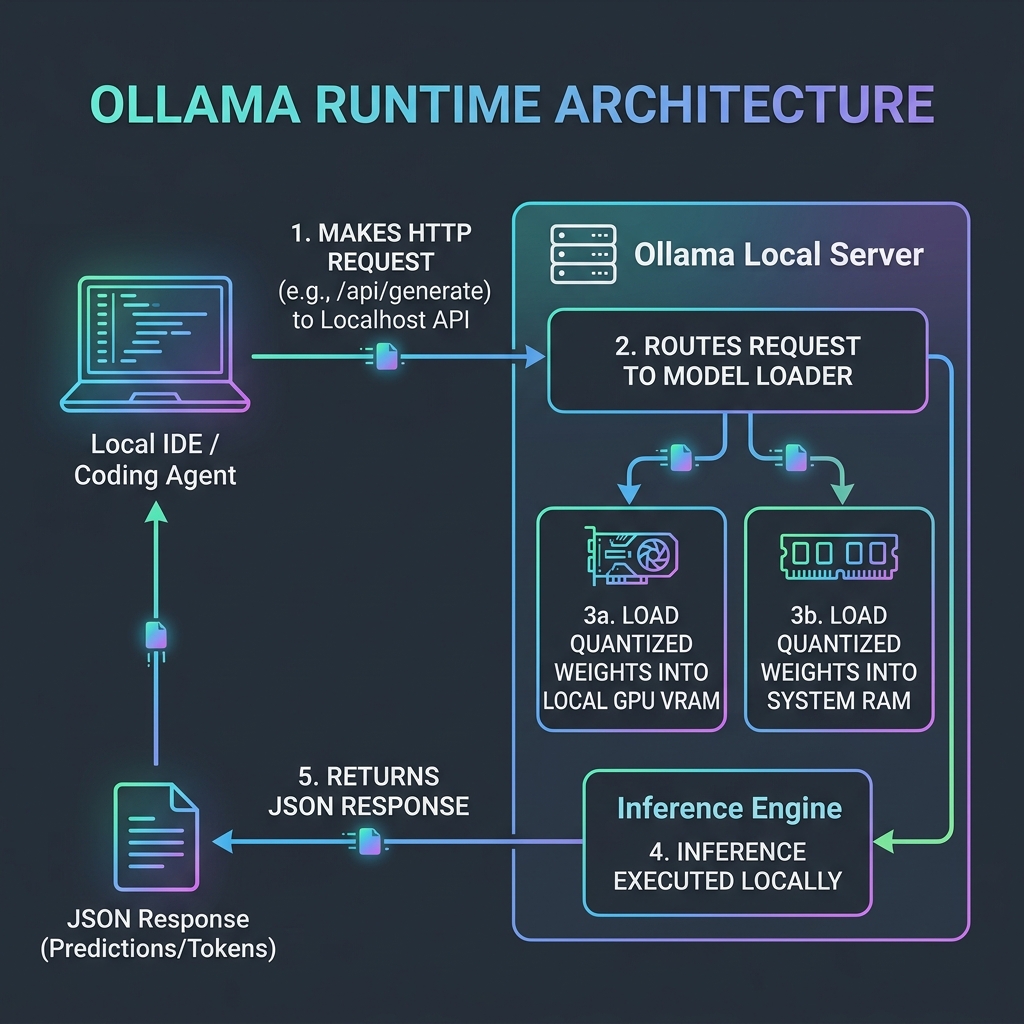
Figure 2: The Ollama Architecture \\\\u2014 how local IDEs connect to localhost APIs to perform secure, high-speed inference.
To integrate local models into their workflow, developers are pairing Ollama with standard terminal tools and extensions. A typical local stack consists of:
| Component | Tooling | Role |
|---|---|---|
| Local LLM Runtime | Ollama | Manages model weights, zapier-alternatives-that-actually-handle-complex-logic" class="internal-link">handles quantization, and exposes a localhost API. |
| Model Tier | Qwen-2.5-Coder / Llama-3.1-8B | Underlying open-weights models optimized for code completion and instruction following. |
| IDE Interface | Cursor / VS Code with Continue.dev | Sends editor cursor context to the localhost API for inline autocomplete and chat. |
| Terminal Agent | Aider / Local coding agents | Navigates codebases, edits files, and runs git commands autonomously using local model endpoints. |
The configuration of this stack is remarkably simple. Once Ollama is installed, a developer can download and serve a specialized coding model with a single terminal command:
# Pull and serve Qwen-2.5 Coder locally
ollama run qwen2.5-coder:7b
This command automatically initializes a local API server on `http://localhost:11434`, exposing an OpenAI-compatible endpoint that any developer extension can query.
The Ollama Effect is the first step toward a broader local-first engineering philosophy. As desktop hardware continues to scale\\\\u2014with specialized NPU (Neural Processing Unit) silicon becoming standard on consumer laptops\\\\u2014the quality gap between local open-weights models and massive cloud APIs is closing. For developers, the message is clear: the future of AI engineering is local-first, private, and running directly on your desktop.
Before Ollama, running a large language model locally required navigating a fragmented landscape of installation complexity, CUDA version management, model format conversions, and API server configuration. The experience was accessible only to ML engineers comfortable with Python environment management and GPU driver troubleshooting. Ollama changed this with a design philosophy that prioritized developer experience over raw flexibility — a tradeoff that proved dramatically more valuable for adoption than the complexity-tolerant alternatives.
The Ollama design makes three critical choices that define its appeal. First, it packages models as self-contained artifacts (the Modelfile format, inspired by Dockerfiles) that include the model weights, quantization configuration, context window settings, and system prompt in a single downloadable unit. This eliminates the coordination overhead of managing separate weight files, configuration files, and system prompt templates. Second, it exposes a local HTTP API that is intentionally compatible with the OpenAI API schema — any application built against the OpenAI API can point its base URL at localhost:11434 and begin using a local model with zero code changes. Third, it manages GPU and CPU resource allocation automatically, detecting available hardware and configuring inference to run on the best available compute without user intervention.
These design choices made Ollama the de facto standard for local LLM deployment in 2025-2026, reaching 5 million downloads per month by June 2026. The open-source model ecosystem migrated toward Ollama compatibility as a baseline requirement — models hosted on Hugging Face increasingly include Ollama Modelfiles, and the Ollama model library (https://ollama.ai/library) has become a primary distribution channel for open-source LLMs. The developer desktop stack has fundamentally reorganized around Ollama as the local inference layer, connecting to broader self-hosted AI strategies.
The practical performance question for development teams considering Ollama is: for their specific workloads, what is the quality and cost trade-off between Ollama-served local models and cloud LLM APIs? The answer varies significantly by task type, hardware, and model selection, and generic comparisons are often misleading.
For code completion and generation, local models via Ollama have reached near-parity with cloud APIs on common tasks. Codestral 22B served via Ollama on an M3 Max MacBook Pro achieves 92% of GPT-4o performance on HumanEval, at 35 tokens per second, with zero API latency overhead. For a developer doing active coding assistance, the effective user experience is comparable to GitHub Copilot's cloud-backed performance. For complex architectural reasoning, multi-file context, and cutting-edge coding tasks, frontier cloud models maintain a meaningful quality advantage. The practical recommendation for development teams: use local Ollama for daily coding assistance (where the cost savings and privacy benefits are significant), and reserve cloud API calls for complex architectural planning sessions where frontier model quality matters.
For text processing tasks (summarization, classification, extraction), local models have largely reached production-adequate quality for most use cases. Llama 3 70B via Ollama on an A100 workstation matches or exceeds GPT-3.5-Turbo quality on standard NLP benchmarks and runs at 30-45 tokens per second. For organizations processing high volumes of documents (thousands per day), the economics strongly favor local inference: at $0.002/1K tokens for GPT-3.5-Turbo, processing 1 million tokens daily costs $2,000/month. The same workload on a self-hosted A100 instance costs $800-1,200/month in cloud compute, with amortized hardware costs making on-premise even cheaper for sustained high-volume workloads. The economics get even more favorable when you factor in the privacy and compliance benefits of keeping sensitive document content on-premise rather than transmitting it to third-party APIs, as analyzed in our comparison of local vs cloud AI for European enterprises.
The maturation of Ollama as a local inference standard has enabled a new category of application architecture: Ollama-native applications that are designed from the ground up to run entirely locally, with optional cloud sync for backup and cross-device access but no cloud dependency for core functionality.
The Ollama-native architecture pattern uses three components: an Ollama backend running local model inference, a local vector database (Qdrant, Chroma, or LanceDB) for semantic search and RAG, and a local-first application layer (typically a desktop application or Electron app) that provides the user interface and orchestrates the interaction between the user, the vector database, and the Ollama backend. The application has no hard dependency on any cloud service — it functions fully offline on hardware where these three components run.
Prominent applications built on this pattern include: Anything LLM (local RAG chat over documents), Open Webui (ChatGPT-like interface for Ollama), Msty (multi-model conversation interface), and Continue (VS Code extension for Ollama-backed code assistance). Each of these applications has reached tens or hundreds of thousands of active users, demonstrating that the Ollama-native architecture is viable at scale. For development teams evaluating this pattern for their own applications, the key technical considerations are: hardware requirements (users need at minimum 8GB RAM for small models, 16GB+ for productive coding assistance models), model distribution (the first-run model download of 4-40GB depending on model size requires user patience and bandwidth), and update management (model weight updates when new model versions are released require re-download and cache invalidation). These challenges are solvable with good UX design and are generally outweighed by the privacy, cost, and offline capability benefits for the target user segments these applications serve. For teams building privacy-first applications, combining Ollama-native architecture with the principles discussed in the zero-server AI stack approach creates comprehensive local-first AI product strategies.
Ollama is a local LLM runtime that dramatically simplifies running large language models on your own hardware. It packages models as self-contained Modelfiles, exposes an OpenAI-compatible local HTTP API, and manages GPU/CPU resource allocation automatically. It made local LLM deployment accessible to developers without ML engineering backgrounds.
Ollama exposes a local HTTP API (localhost:11434) that is intentionally schema-compatible with the OpenAI API. Any application built against the OpenAI Python SDK or REST API can switch to Ollama by changing the base URL — no code changes required. This compatibility made Ollama adoption trivially easy for existing LLM application developers.
For daily coding assistance: Codestral 22B (best code quality among locally-runnable models), Llama 3.1 8B (excellent speed/quality balance for 8GB RAM devices), and Qwen2.5-Coder 7B (strong for Python and JavaScript). All achieve 85-92% of GPT-4o HumanEval performance at zero API cost.
An Ollama-native application is built to run entirely locally using Ollama for LLM inference, a local vector database for RAG, and a local-first application layer — with no cloud dependency for core functionality. Examples include Anything LLM, Open Webui, and Continue (VS Code extension). These apps work fully offline once model weights are downloaded.
For development teams: Ollama is economical for high-frequency tasks (daily coding assistance, document processing) where API fees accumulate. Cloud APIs are better for occasional complex tasks needing frontier model quality. For production: above 500,000 tokens/day, self-hosted inference typically becomes cheaper than cloud APIs, accounting for hardware costs and management overhead.