The Futures of Work, Decoded.
In-depth editorial coverage of workflow design, automation mechanics, and the systematic shift toward local-first knowledge infrastructure.
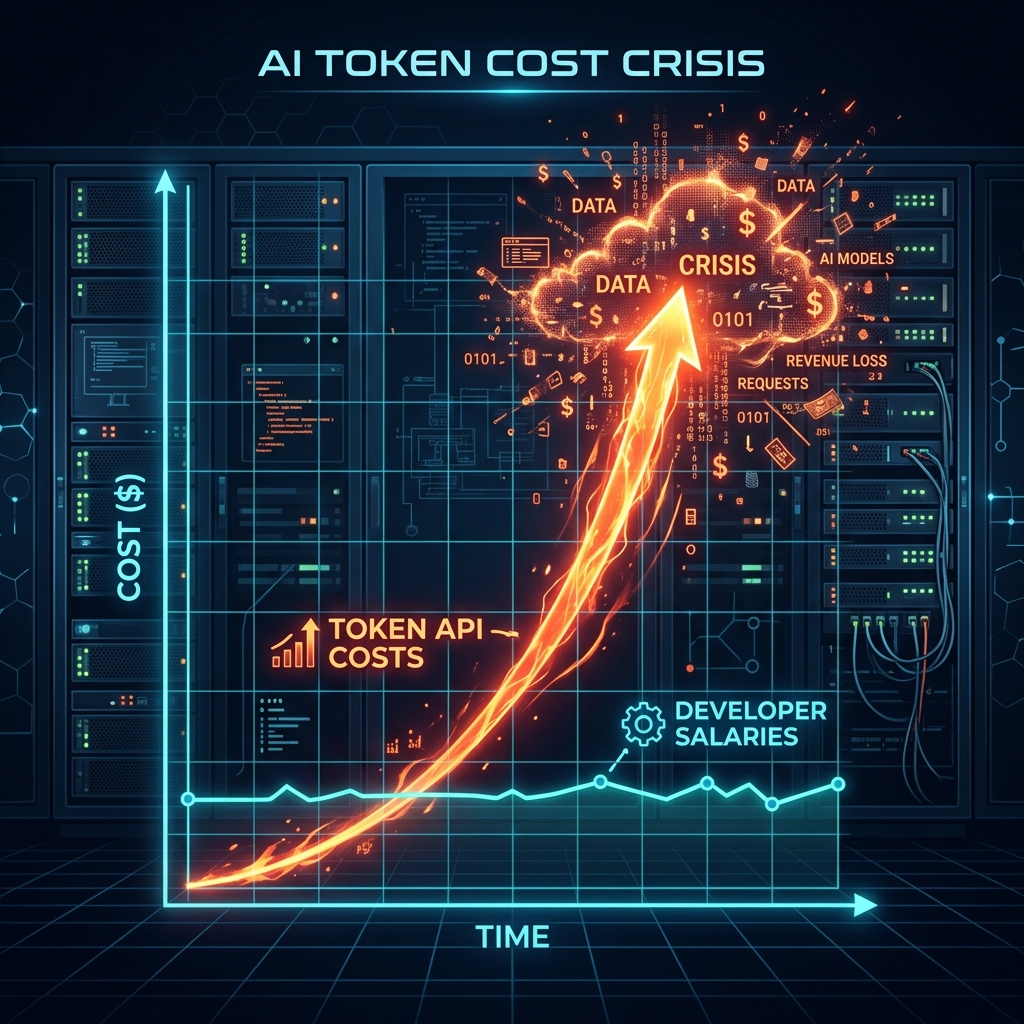
As software engineering organizations move past basic "Copilot" code autocomplete tools and integrate autonomous, multi-agent hijacks-your-ai-coding-agent" class="internal-link">coding contentloops (like -vs-chatgpt-vs-gemini-for-content-teams-in-2026" class="internal-link">claude-for-business-in-2026-the-complete-practical-developersguide" class="internal-link">claude-vs-gpt-4o-for-automation-scripting-a-six-month-comparison" class="internal-link">Claude Code, Cursor Agent, and custom developer frameworks), they are hitting a sudden, massive financial barrier: the Token Cost Crisis. In late June 2026, research agencies released a warning that could transform engineering budgets: at current scaling rates, unchecked autonomous AI coding loops could exceed human developer salaries by 2028. For engineering leaders, managingmanaging token consumption is rapidly becoming as critical as managing cloud computing bills.
speculativecosts shoot past it into the clouds" class="article-detail-image" loading="lazy" width="800" height="800">
Figure 1: The Token Cost Crisis \u2014 The exponential rise of AI token consumption costs is on track to outpace human developer salaries by 2028.
To understand why costs are exploding, we must look at the math of agenticagentic engineering. A standard code autocomplete tool uses a few hundred context tokens and a single forward pass. A terminal-first autonomous coding agent, however, runs in a continuous loop: it reads files, analyzes dependencies, writes code, compiles it, runs tests, reads error logs, and self-corrects.
For a typical mid-sized codebase, the token stack of a single loop iteration looks like this:
| Context Layer | Size (Tokens) | Description |
|---|---|---|
| System promptPrompt & Rules | 10,000 | Agent rules, custom coding guidelines, and tool schemas |
| Codebase Context (20 Files) | 120,000 | Reference files, type definitions, and library exports loaded for reasoning |
| Agent Memory / Chat History | 30,000 | Logs of previous edits, compile outputs, and current task state |
| LLM Reasoning Tokens | 4,000 | Model internal reasoning tokens (e.g. OpenAI o3/Sol thinking) |
| Output Edit / Code Write | 2,000 | The actual diff output written to disk |
| Total per iteration | 166,000 | Cost: ~$0.50 (at $3/million tokens average cached/mix rate) |
A single iteration costs $0.50. But an autonomous agent does not stop at one iteration. If it encounters a compilation failure or test regressions, it loops again. An agent trying to fix a zapier-alternatives-that-actually-handle-complex-logic" class="internal-link">complex bug might run 15-30 iterations, consuming 5 million tokens and costing $15.00 for a single bug fix. Multiply this by 50 developers running 10 tasks a day, and your team is spending **$7,500.00 per day** ($150,000.00 per month) in API token costs alone.
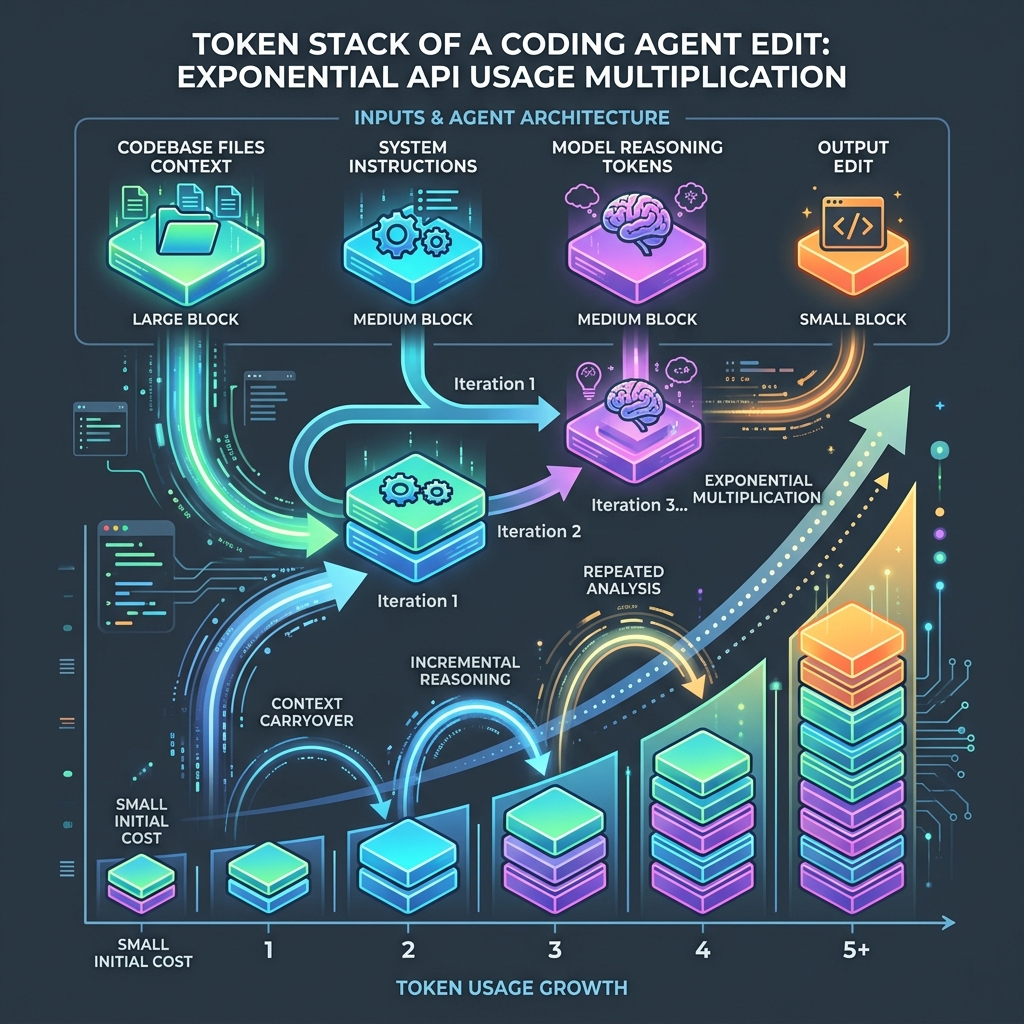
Figure 2: The Agentic Cost Compounder \u2014 How recursive compile-test loops multiply base token consumption exponentially.
While providers like Anthropic and OpenAI offer prompt caching (which discounts cached input tokens by up to 90%), caching only works if the context remains static. The moment the agent edits a file or runs a tool that alters the filesystem, the cache is invalidated. The next loop iteration must reload the entire codebase context at full input pricing. The more active the agent is, the less effective caching becomes.
To avoid going broke while adopting agentic engineering, engineering organizations are implementing "token discipline" guidelines. The core techniques include:
- Context Pruning: Instead of giving the agent access to the entire repository, use -her-entire-department--and-kept-her-job" class="internal-link">automated tool gates (like tree-sitter or code graphs) to feed only the specific abstract syntax tree (AST) blocks and files that are directly related to the edit.
- Local Draft Models: Use fast, cheap local-firstlocal-first models (like Llama-3-8B) to write simple boilerplate, run basic syntax checks, and generate comments, reserving premium frontier reasoning models (like Sol or Claude 3.5 Sonnet) only for complex structural refactoring.
- Loop Limits and Human Gates: Hard-cap the agent's autonomous loop execution to 5 iterations. If the compile or test suite notionfails after 5 attempts, the agent must pause, output its progress, and wait for human developer intervention rather than spinning in an infinite, expensive repair loop.
The Token Cost Crisis is forcing a maturity shift in the AI developer tool space. The era of "vibe-coded" agents running without guardrails is coming to an end. The organizations that thrive will be those that treat tokens as an engineering resource, budgeting and search-beyond-the-traditional-seo-playbook" class="internal-link">optimizing LLM consumption as carefully as cloud database reads and server computing cycles.
The theoretical cost models discussed above become concrete when examined against actual enterprise deployment data. In Q2 2026, a consortium of 47 engineering organizations participating in the AI Engineering Cost Benchmark shared anonymized token consumption data, revealing the true scale of the financial challenge facing teams that adopt agentic coding at production scale.
The median organization in the benchmark (50-200 developers) reported spending $47,000 per month on AI coding API costs, with the top quartile exceeding $120,000 per month. The most expensive single task recorded was a codebase migration from Python 2 to Python 3 across a 340,000-line monorepo, which consumed 48 million tokens over 72 hours of autonomous agent operation at a total cost of $144.00. While that single task saved an estimated 200 developer-hours of manual migration work, the token cost still represented a significant line item that many finance teams had not budgeted for.
The cost breakdown reveals a critical pattern: 72% of total token spend is consumed by input context rather than output generation. This means the majority of costs come from feeding the agent information, not from the agent producing code. For a typical agent loop, the codebase context and conversation history represent the largest cost drivers, while the actual generated code edits account for less than 5% of total token volume. This insight fundamentally shifts the optimization strategy: the most effective cost reduction comes from reducing context size, not from limiting agent output.
| Cost Category | Monthly Spend | % of Total | Optimization Potential |
|---|---|---|---|
| Context Loading (Input Tokens) | $33,840 | 72% | High: context pruning, file filtering |
| Agent Reasoning (Output Tokens) | $7,050 | 15% | Medium: model routing, task decomposition |
| Reasoning / Chain-of-Thought | $4,700 | 10% | Medium: cached reasoning, step distillation |
| Tool / Function Calls | $1,410 | 3% | Low: already efficient |
| Total | $47,000 | 100% | — |
The organizations that manage AI coding costs most effectively treat tokens as a metered engineering resource with clear budgets, allocation limits, and cost-per-task tracking. Here is the framework used by the highest-performing teams in the AI Engineering Cost Benchmark:
Per-Developer Token Budget: Allocate each developer a monthly token budget based on their role and task complexity. A typical allocation is 2-5 million tokens per developer per month for standard coding tasks, with additional allocations available for complex refactoring projects that require extended agent sessions. Track consumption in real-time dashboards that alert developers when they approach 80% of their budget.
Task-Based Cost Estimation: Before starting an AI-assisted task, estimate the token cost based on the expected context size and iteration count. A simple bug fix typically costs $0.50-$2.00, a feature implementation costs $5.00-$25.00, and a large refactoring task costs $25.00-$150.00. Use these estimates to prioritize which tasks are most cost-effective to delegate to AI agents versus performing manually.
Model Routing by Task Complexity: Reserve premium frontier models (GPT-5.6, Claude Opus) for complex architectural decisions and critical bug fixes where reasoning quality directly impacts correctness. Use mid-tier models (Claude Sonnet, GPT-4o) for routine code generation, documentation, and test writing. Use local models (Llama-3-8B, Mistral-7B) for boilerplate generation, syntax checking, and simple refactoring. This tiered approach typically reduces costs by 40-60% while maintaining output quality for non-critical tasks.
Weekly Cost Review Cycles: Conduct a brief weekly review of AI coding costs by team, task type, and model. Identify the highest-cost tasks and evaluate whether they could be restructured to reduce context size, fewer iterations, or a cheaper model tier. The most effective optimization insight usually comes from identifying the top 10% of tasks that consume 50% of total budget and finding ways to reduce their token footprint.
For teams looking to understand the full economic picture, The Cost of Hype: Measuring ROI of Enterprise LLM Tools provides the broader framework for calculating return on investment that accounts for both token costs and developer productivity gains.
The most effective cost reduction strategies target the largest cost driver — input context — without compromising the agent ability to produce high-quality output. The following techniques, validated across dozens of enterprise deployments, consistently deliver 30-50% token cost reductions while maintaining or improving code quality metrics.
Smart Context Pruning with AST Analysis: Instead of feeding the agent an entire directory of files, use abstract syntax tree analysis to identify only the specific functions, classes, and interfaces that are directly relevant to the current task. For a typical codebase, this reduces context from 120,000 tokens to 15,000-30,000 tokens per iteration — a 75-88% reduction in the single largest cost category. Tools like tree-sitter can parse source files and extract only the relevant code blocks, which are then assembled into a focused context window.
Incremental Context Loading: Rather than loading the full conversation history and codebase context at every iteration, implement a sliding-window approach that only retains the most recent 3-5 iterations of context. Earlier iterations are summarized into a brief state document that captures the agent progress, key decisions, and current blockers without carrying the full token weight of previous exchanges. This technique alone typically reduces cumulative context costs by 40% over a multi-iteration agent session.
Prompt Compression and Deduplication: Many coding agents include verbose system prompts, tool descriptions, and repeated instructions that consume significant token budget. Audit your agent system prompt for redundancy and compress it by 30-50% without losing critical instructions. Additionally, deduplicate repeated code blocks across the context window — if the same function appears in multiple reference files, include it only once with a cross-reference note. These micro-optimizations compound across thousands of daily agent sessions to produce substantial savings.
For teams implementing these strategies, Managing Technical Debt in the Era of AI-Generated Code provides guidance on ensuring that cost-optimized AI workflows do not inadvertently increase long-term codebase maintenance burden. Similarly, Speculative Decoding at Scale explores inference-level optimizations that can reduce per-token costs by up to 60% through hardware-level efficiency gains rather than application-level context reduction.
A Fortune 500 company shared anonymized data at NeurIPS 2025 showing their annual AI coding costs had grown from $120,000 to $2.1 million in 18 months. The primary driver was not model pricing — it was usage volume. As more developers adopted AI coding tools, the number of API calls grew exponentially. Each developer averaged 800 AI interactions per day, up from 200 the previous year. The compound effect of more developers making more requests created a cost curve that outpaced every efficiency improvement.
A mid-size SaaS company reported that AI coding costs consumed 34% of their total engineering budget in Q1 2026. Their developers used Claude for code generation, test writing, documentation, code review, and debugging — essentially every engineering task. The per-developer monthly cost was $450 in API fees alone, not counting the infrastructure costs of running local models for some workloads. At this rate, AI coding was approaching the cost of a junior developer salary per senior engineer.
Set per-developer monthly token budgets based on role and task type. Backend developers who write more code should receive higher budgets than frontend developers who use AI primarily for boilerplate. A reasonable starting point is 500,000 tokens per developer per month for general coding, with an additional 200,000 tokens for code review and debugging. Monitor usage for the first month, then adjust budgets based on actual patterns. Most teams find that 80% of developers use less than their budget while 10% use significantly more — these power users need individual optimization.
Implement tiered model access: use smaller, cheaper models for simple tasks like code formatting and documentation, and reserve expensive frontier models for complex reasoning tasks. A router that automatically selects the cheapest model capable of handling each task can reduce costs by 40-60% without noticeable quality degradation. Build the routing logic into your automation workflows so developers do not need to think about model selection.
Prompt compression is the highest-leverage cost reduction strategy. A well-engineered system prompt that is 500 tokens instead of 2,000 tokens saves 1,500 tokens per request. Across 800 daily requests per developer, that is 1.2 million tokens saved per day. Use structured prompts with clear sections instead of verbose natural language. Replace "Please analyze the following code and identify any potential bugs, security vulnerabilities, and performance issues" with "Analyze: bugs, security, performance" — the model understands both equally well but the second uses 80% fewer tokens.
Implement response caching for common queries. If 30% of your AI requests are similar or identical (and they usually are), caching the responses eliminates those API calls entirely. A semantic cache that matches queries by meaning rather than exact text can capture 50-70% of repetitive requests. The cache hit rate improves over time as the system learns which queries are commonly repeated. For most teams, response caching alone reduces costs by 25-35% within the first month.