The Futures of Work, Decoded.
In-depth editorial coverage of workflow design, automation mechanics, and the systematic shift toward local-first knowledge infrastructure.

For the past few years, the availability of frontier Artificial Intelligence models was governed solely by commercial API limits and server credits. Developers anywhere in the world could sign up for an OpenAI or Anthropic account, input a credit card, and query the most advanced cognitive engines available. That open access model is officially coming to an end. OpenAI's launch of **GPT-5.6 Sol** and Anthropic's restricted deployment of **Mythos AI** represent a fundamental structural shift: the transition from public developer platforms to nation-state vetted, restricted-access sovereign models. Under new auditing frameworks set by the US government, access to these systems is limited to vetted organizations, requiring strict security sandboxing and identity auditing. This article examines the technical profiles of GPT-5.6 Sol and Anthropic Mythos, their vetting pipelines, and how software teams must adjust their deployment strategies in the era of audited computing.
Figure 1: OpenAI's GPT-5.6 Sol and Anthropic's Mythos AI are hosted under strict government-audited server setups, limiting query access to vetted teams.
What led to this shift? As AI models surpassed specific compute thresholds\\u2014specifically crossing 10^26 FLOPs during training\\u2014concerns regarding national security, advanced cyber-offense automation, and biological synthesis guidance prompted government regulators to step in. Under the new licensing guidelines, developers cannot run frontier weights locally, nor can providers host them on public internet gateways without a compliance proxy. Instead, models like GPT-5.6 Sol and Mythos AI are hosted in highly secure virtual private clouds (VPCs) with strict telemetry logging:
- **Compliance Proxies**: All queries are intercepted by an audit gateway that evaluates the promptprompt for high-risk topics (cyber warfare, infrastructure penetration, chemical engineering).
- **Identity Auditing**: API keys are tied to physical organizational registry codes (e.g. DUNS number and corporate tax IDs) rather than standard developer accounts.
- **Egress Limits**: Response lengths and structured JSON schemas are restricted to prevent the reconstruction of model weights or prompt extraction codingattacks.
| Vetting Dimension | OpenAI GPT-5.6 Sol | Anthropic Mythos AI |
|---|---|---|
| Primary Focus | Advanced scientific reasoning and code execution | Autonomous agenticagentic workflows and multi-step tasks |
| Access Level | Government-vetted US/NATO corporations only | Trusted research labs and selected defense contractors |
| Vetting Requirement | Identity verification, background checks, VPC proxy | Hardware-level security sandbox, zero data retention |
| Auditing Gateway | Real-time prompt checking and token telemetry logs | Stateless local audit agent (Strict compliance proxy) |
| Model Size (Estimated) | Multi-trillion parameter MoE (Mixture of Experts) | Dense transformer optimized for low-latency reasoning |
To deploy these models in enterpriseenterprise setups, systems engineers must construct a secure compliance pipeline. Instead of sending queries directly from the client to the model endpoint, queries must pass through a local **Audit Proxy** that strips out sensitive personal identifiable information (PII) and validates the query against security compliance filters before passing it to the government-monitored VPC gateway:
import requests
import json

class SecureComplianceProxy:
    def __init__(self, api_key, gateway_url):
        self.api_key = api_key
        self.gateway_url = gateway_url

    def submit_query(self, prompt, organization_id):
        # 1. Local pre-audit: filter forbidden terms
        if self._contains_forbidden_terms(prompt):
            raise ValueError("Query rejected: contains security-sensitive terms")

        # 2. Structure request with required organization telemetry headers
        headers = {
            "Authorization": f"Bearer {self.api_key}",
            "X-Compliance-Org-ID": organization_id,
            "Content-Type": "application/json"
        }

        payload = {
            "model": "gpt-5.6-sol",
            "messages": [{"role": "user", "content": prompt}],
            "temperature": 0.0 # Force deterministic output for auditability
        }

        response = requests.post(
            f"{self.gateway_url}/v1/chat/completions",
            headers=headers,
            data=json.dumps(payload)
        )

        if response.status_code == 403:
            raise PermissionError("Access denied: Vetting gateway flagged query")

        return response.json()

    def _contains_forbidden_terms(self, prompt):
        forbidden_keywords = ["exploit", "biological", "nuclear", "weapon", "infrastructure bypass"]
        return any(kw in prompt.lower() for kw in forbidden_keywords)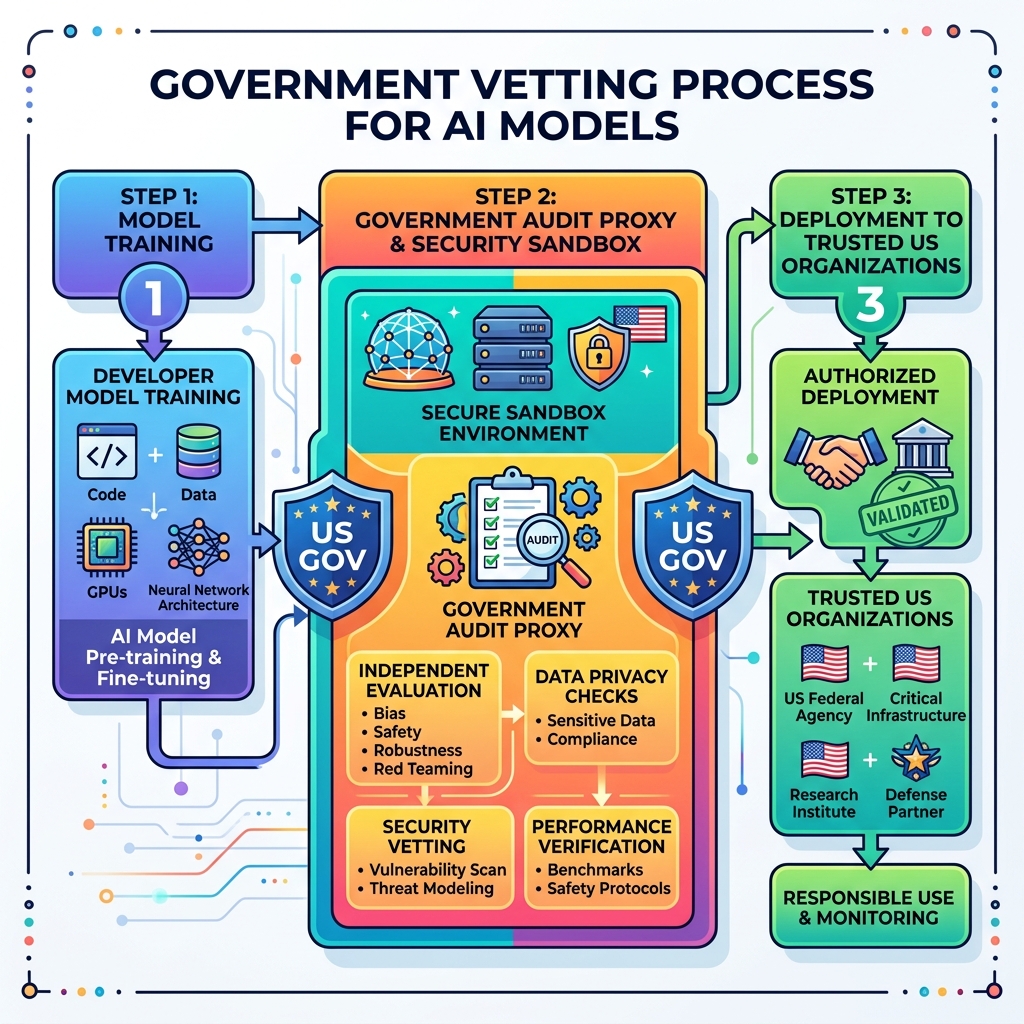
Figure 2: The vetted deployment pipeline: requests pass through an audit proxy before being processed by secure models and deployed to vetted enterprises.
As the U.S. and Europe tighten their digital borders, developers will witness the fragmentation of the global LLM framework. While open weights models (like Meta's Llama or Mistral's Mixtral) will continue to power standard corporate tools and consumer apps, the most advanced logical capabilities (vetted by bodies like the US automatedDepartment of Commerce and the EU AI Board) will remain locked behind government-vetted APIs. managingManaging the compliance audit proxies and coordinating these sovereign connections will become the core focus for next-generation systems engineers.
The arrival of GPT-5.6 Sol and Anthropic Mythos AI under strict licensing signals the end of the laissez-faire API market. By implementing compliance gatekeeping, local logging proxies, and hardware sandboxes, the tech industry is adjusting to a world notionwhere raw AI power is treated as a strategic national resource. Understanding these security protocols today is key to buildingbuilding resilient, enterprise-compliant AI workflows tomorrow.
Data residency is no longer a theoretical concern. It is a hard legal constraint that determines which AI models you can deploy and where. The patchwork of regulations varies dramatically by jurisdiction, creating a complex compliance landscape for organizations operating across borders. Understanding these requirements is essential before choosing between sovereign and public cloud AI deployments.
European Union: The EU AI Act, effective August 2026, combined with GDPR, creates the world's strictest data residency framework. Training data must be processed within EU borders for high-risk AI systems, and personal data cannot be transferred outside the EU without adequacy decisions or standard contractual clauses. The EU AI Act compliance requirements are reshaping how enterprises architect their AI infrastructure, with many opting for EU-hosted sovereign models like GPT-5.6 Sol's Frankfurt deployment.
United States: The U.S. takes a sector-specific approach. Federal agencies must comply with FedRAMP High or IL5 requirements, mandating that data stays on U.S.-soil infrastructure with specific security controls. Healthcare organizations face HIPAA constraints that limit where PHI can be processed. The DoD's AI adoption framework explicitly requires sovereign cloud deployments for classified and controlled unclassified information, making Anthropic's government-vetted Mythos model a compelling option for defense contractors.
China: The Personal Information Protection Law (PIPL) and Data Security Law (DSL) require that personal data of Chinese citizens be stored within China. Cross-border data transfers require security assessments by the Cyberspace Administration of China (CAC). For AI models, this means that training on Chinese user data must happen domestically, and models cannot be exported without government approval. Public cloud providers must partner with local entities to operate, which is why sovereign LLM deployments are the only viable path for most enterprises operating in the Chinese market.
India: The Digital Personal Data Protection Act (DPDPA) of 2023 introduced data localization requirements for certain categories of personal data. While India has not yet mandated full data residency for AI workloads, the Reserve Bank of India requires financial data to be stored domestically, and the government's AI advisory council has recommended similar requirements for AI training data. Organizations operating in India should plan for eventual data residency mandates in their AI architecture decisions.
The economics of sovereign AI deployment versus public cloud AI access present a stark trade-off between cost efficiency and regulatory compliance. A detailed cost analysis reveals that while sovereign deployments carry higher upfront costs, they can be more economical at scale for organizations with strict compliance requirements.
Public cloud AI costs typically follow a pay-per-token model. GPT-4o-class models cost $5-15 per million input tokens and $15-60 per million output tokens. For a mid-size enterprise processing 100 million tokens daily, this translates to $500-6,000 per day or $15,000-180,000 per month. The advantage is zero infrastructure management and instant scalability.
Sovereign cloud AI costs involve infrastructure overhead but offer predictable pricing. Deploying a sovereign LLM on dedicated infrastructure (typically a GPU cluster with 8-32 A100 or H100 GPUs) costs $15,000-50,000 per month in cloud compute, plus $5,000-15,000 for the model license or fine-tuning costs. Total monthly costs range from $20,000-65,000. The break-even point typically occurs at around 50 million tokens per day, above which threshold sovereign deployments become more cost-effective.
Hidden costs of public cloud AI include data transfer fees (which can add 15-30% for cross-border traffic), compliance audit costs ($50,000-200,000 annually), and the opportunity cost of regulatory delays. When a public cloud AI deployment requires a Data Protection Impact Assessment (DPIA) under GDPR, the compliance process alone can take 3-6 months and cost $100,000-300,000 in legal and consulting fees.
Migrating from public cloud AI to sovereign deployments requires careful planning to avoid disruption. Here is a phased approach that minimizes risk while maintaining business continuity.
Phase 1: Assessment and Classification (Weeks 1-4). Audit your AI workloads to classify them by data sensitivity and regulatory requirements. Identify which workloads MUST be sovereign (government data, PII, financial records) versus which can remain on public cloud (marketing content, internal knowledge bases). This classification drives your sovereign deployment scope and prevents over-investment in unnecessary infrastructure.
Phase 2: Infrastructure Provisioning (Weeks 5-12). Deploy your sovereign AI infrastructure in the appropriate jurisdiction. This typically involves spinning up GPU clusters in sovereign cloud providers (AWS GovCloud, Azure Government, or regional providers like Scaleway for EU deployments). Install and configure your chosen sovereign LLM, whether it is a government-vetted model like GPT-5.6 Sol or a fine-tuned open-source model like Llama 3.4 with domain-specific adaptations.
Phase 3: Model Adaptation and Testing (Weeks 13-20). Sovereign models may not perfectly match public cloud model performance out of the box. Fine-tune on your domain-specific data, run parallel evaluations comparing sovereign and public cloud outputs, and establish quality thresholds. Create a workflow automation layer that can route requests to either sovereign or public cloud models based on data classification, enabling a gradual migration without a hard cutover.
Phase 4: Traffic Migration and Monitoring (Weeks 21-28). Gradually shift traffic from public cloud to sovereign deployments using a canary migration approach. Start with 5% of traffic, monitor latency, accuracy, and cost metrics, then incrementally increase. Maintain the ability to fall back to public cloud if sovereign performance degrades. Implement comprehensive logging and audit trails to satisfy regulatory requirements and demonstrate compliance during audits.
The migration timeline of 28 weeks may seem long, but it reflects the reality of building sovereign AI infrastructure that meets regulatory requirements. Organizations that rush this process often face costly rework or compliance failures. The investment pays dividends in reduced regulatory risk, predictable costs, and the competitive advantage of being able to serve government and enterprise clients who require sovereign deployments.
Germany requires that personal data of EU citizens remain within EU borders unless adequate protection agreements exist. The BSI (Federal Office for Information Security) maintains a cloud computing security catalog that sovereign AI providers must meet. France follows similar requirements through CNIL, with additional restrictions on AI systems that process biometric or health data. Both countries mandate that AI inference happen on hardware physically located within the EU, which eliminates most US-based API providers as compliant options.
The UK post-Brexit has diverged from EU requirements but maintains its own data protection framework through the ICO. UK-based sovereign AI solutions must demonstrate compliance with UK GDPR while also meeting sector-specific requirements for financial services and healthcare. This creates a fragmented compliance landscape where a single AI deployment may need different data residency configurations for different customer bases.
Sovereign AI deployments typically cost 2-4x more than equivalent public cloud AI services. A GPT-4o equivalent running on a sovereign cloud in Germany costs approximately $45 per million tokens compared to $10-15 on OpenAI. However, this comparison is misleading because it ignores compliance costs. Organizations that process regulated data through non-compliant public cloud AI face potential fines of up to 4% of global revenue under GDPR. When compliance costs are included, sovereign AI becomes cost-competitive for any organization processing personal data at scale.
The break-even point for sovereign vs public cloud AI typically occurs at around 10 million tokens per month. Below that volume, the per-token cost premium of sovereign AI is manageable. Above that volume, organizations should evaluate dedicated sovereign infrastructure — owning the hardware eliminates the per-token premium entirely after the upfront investment, which pays for itself within 18-24 months for most mid-size companies.
Start with a traffic split: route 10% of your AI requests to the sovereign provider while keeping 90% on your current public cloud setup. Monitor latency, accuracy, and cost for two weeks. If the sovereign provider meets your quality bar, increase to 50%. This gradual approach minimizes risk and gives you a real-world comparison before committing fully. Use a model gateway like LiteLLM to manage the traffic split.
The most common migration blocker is prompt engineering that is tightly coupled to a specific model. If your prompts contain model-specific instructions or rely on particular response formats, you will need to adjust them for the sovereign model. Budget 2-3 weeks for prompt adaptation and testing. Document your prompts in a playbook format so you can track what works with each model and switch providers without starting from scratch.