The Futures of Work, Decoded.
In-depth editorial coverage of workflow design, automation mechanics, and the systematic shift toward local-first knowledge infrastructure.
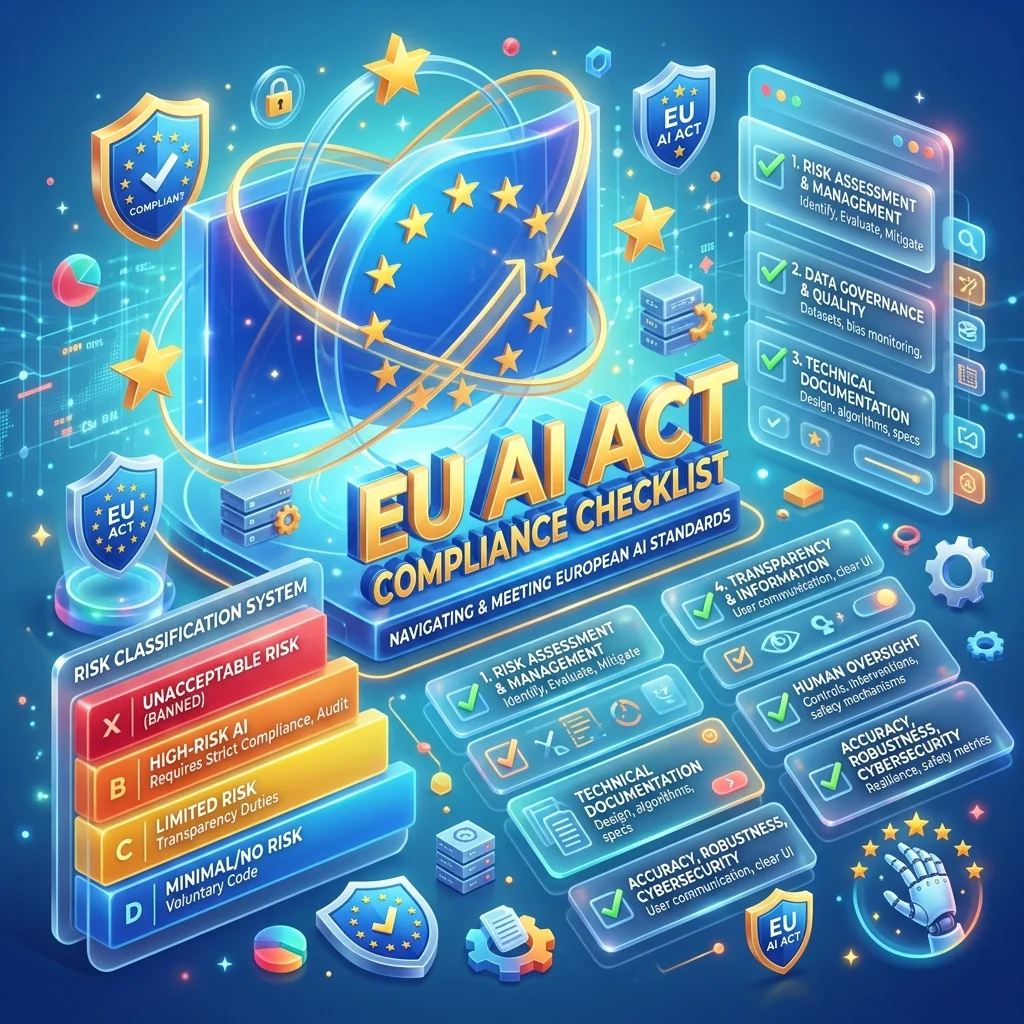
Enforcement of the EU AI Act begins on August 2, 2026, marking a critical transition for software development teams. Compliance is no longer optional for companies deploying systems that affect European citizens. This guide details the technical requirements, logging standards, and risk audits necessary to meet the new legal guidelines. Review our complete checklist on EU developer compliancy to make sure your builds pass initial inspections.
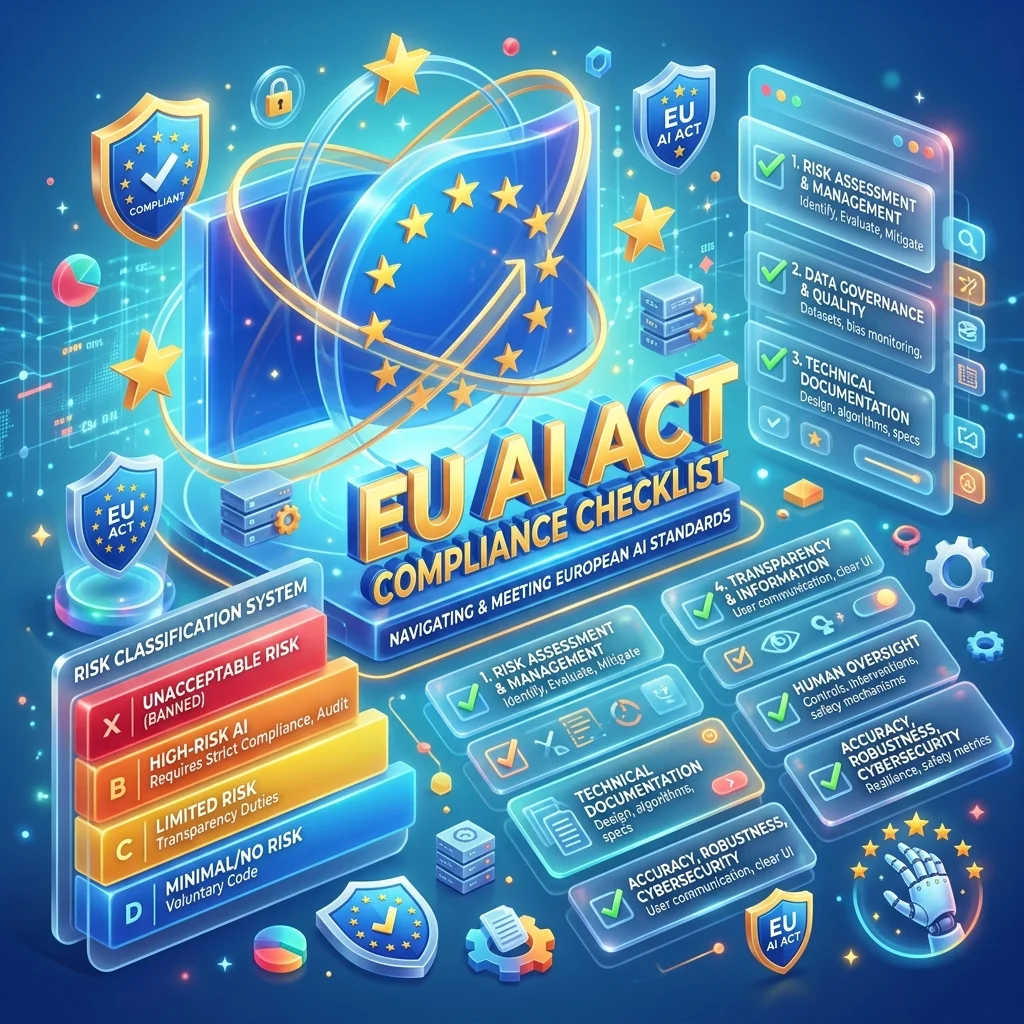
The EU AI Act classifies systems into four tiers based on their potential to cause harm. Prohibited systems are completely banned, while high-risk systems face strict technical audits. Developers must determine where their product fits before writing code. Mistaking your system's category can lead to severe fines. Building compliant distributed workflow pipelines requires analyzing jurisdiction boundaries early in the design cycle.
AI systems that manipulate human behavior or perform untargeted scraping of facial images are banned. These rules have been active since early 2025. Developer teams must audit their databases to ensure no training data violates these bans. Building these features is illegal in the European market.
Systems used in recruitment, credit scoring, and critical infrastructure are classified as high-risk. These applications require a formal conformity assessment before release. Developers must implement continuous testing to monitor model drift and bias. High-risk systems face the most demanding technical documentation rules.
"Classifying your system correctly is the foundation of compliance. High-risk classification triggers a massive documentation burden."
General-Purpose AI (GPAI) models face specific compliance rules under the act. Providers must share detailed technical summaries and respect copyright laws. These rules ensure that foundation models do not introduce systemic risks to the market. Developer teams using third-party APIs must verify their provider's compliance status. This matches details covered in the rise of sovereign model development globally.
Models trained on large compute resources are evaluated for systemic risk. Providers must perform adversarial testing and report energy consumption. If your team trains models locally, you must track compute metrics. Using a compliant provider reduces your team's compliance workload.
GPAI providers must document their training methodologies, data sources, and evaluation metrics. This documentation must be available to regulatory bodies upon request. Developers should confirm that their vendors provide these sheets. Compliance demands transparent reporting across the software supply chain.
Meeting the August 2, 2026 deadline requires modifying your development lifecycle. Teams must build data governance checks and human controls directly into their apps. These features are much harder to add after a product has launched. Compliance requires a structured, code-level approach. Ensure you use a detailed agent auditing checklist to test model output stability.
High-risk systems require training datasets that are representative and free of major bias. Developers must build validation pipelines to scan training databases. You must document data collection sources and cleaning processes. Poor data quality is a major source of regulatory non-compliance.
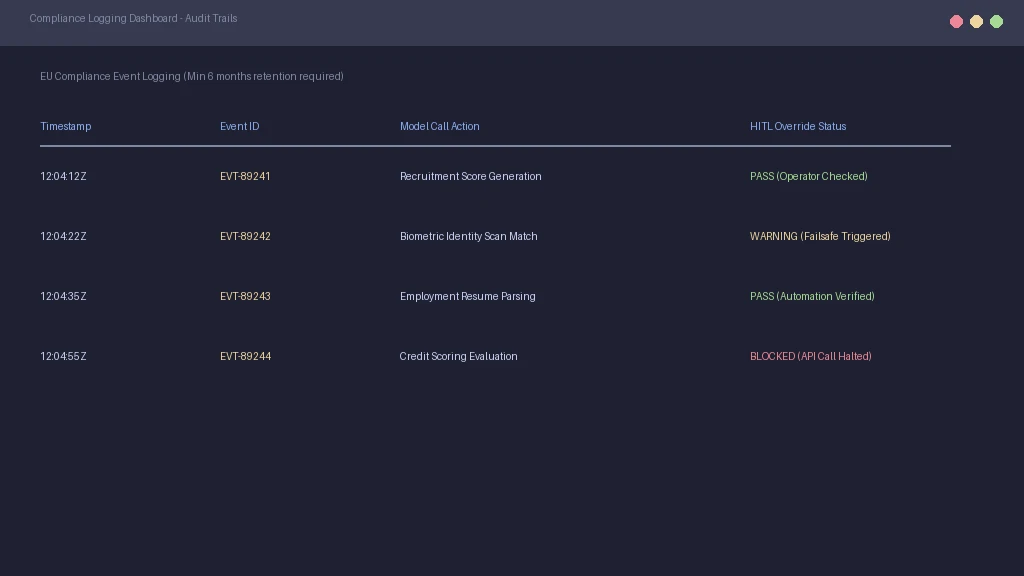
All high-risk applications must include real-time human override controls. Users must be able to halt or reverse AI decisions. Developers should design clear override buttons and safety timeouts. A system that cannot be stopped by a human operator is illegal under the new rules.
Before launching a high-risk system, you must prove compliance through a conformity assessment. This involves auditing your technical documentation and quality systems. Some assessments require third-party verification, while others allow self-assessment. Once completed, you must register your product in the EU database.
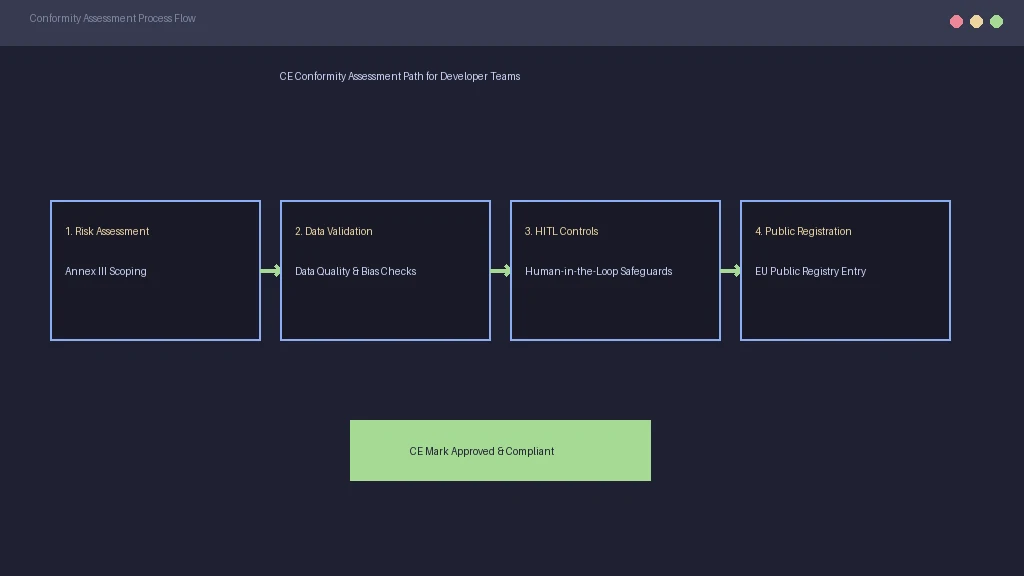
Completing the assessment allows you to apply a CE marking to your product. This mark proves the system meets all European safety and digital standards. Developers must update their project files to include the conformity declaration. This mark is required to distribute your software in the EU.
High-risk systems must be registered in the official EU AI database. This registry is public, allowing citizens to see what systems are active. Registration requires submitting your company details, risk reports, and conformity documents. Maintaining this public listing is a continuous obligation.
The EU AI Act enforces compliance through severe financial penalties. The scale of the fines makes compliance a primary concern for executive boards. Regulatory bodies have the power to audit systems and demand code access. Fines scale with the size and turnover of the violating company. Project planners must calculate the potential enterprise technology ROI before launching compliance audits.
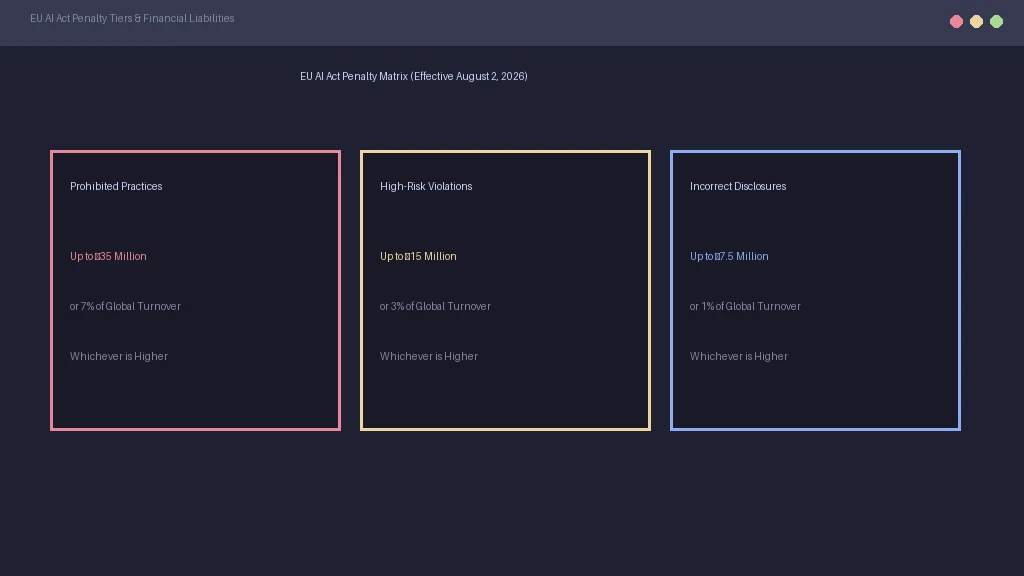
Violating prohibited AI practices triggers fines up to 35 million euros or 7% of global annual turnover. High-risk non-compliance can cost 15 million euros or 3%. These penalties apply to whichever amount is higher. This means even small companies can face crippling fines for major violations.
| Violation Category | Maximum Fine (Fixed) | Global Turnover % |
|---|---|---|
| Prohibited AI Practices | Up to €35 Million | 7.0% |
| High-Risk Non-Compliance | Up to €15 Million | 3.0% |
| Providing Incorrect Information | Up to €7.5 Million | 1.0% |
Small and medium-sized enterprises (SMEs) face adjusted penalty caps. The law attempts to avoid bankrupting startups for minor errors. However, willful negligence still triggers the maximum percentages. Startup teams should review their liability and build compliance into their early designs.
Existing systems built before 2026 are not exempt from the new rules. If an older system undergoes a significant modification, it must meet all current compliance standards. Developers must audit legacy codebases to prepare for this possibility. Updating old systems is often harder than building compliant ones from scratch. Review EU AI Act timelines to set clear engineering schedules.
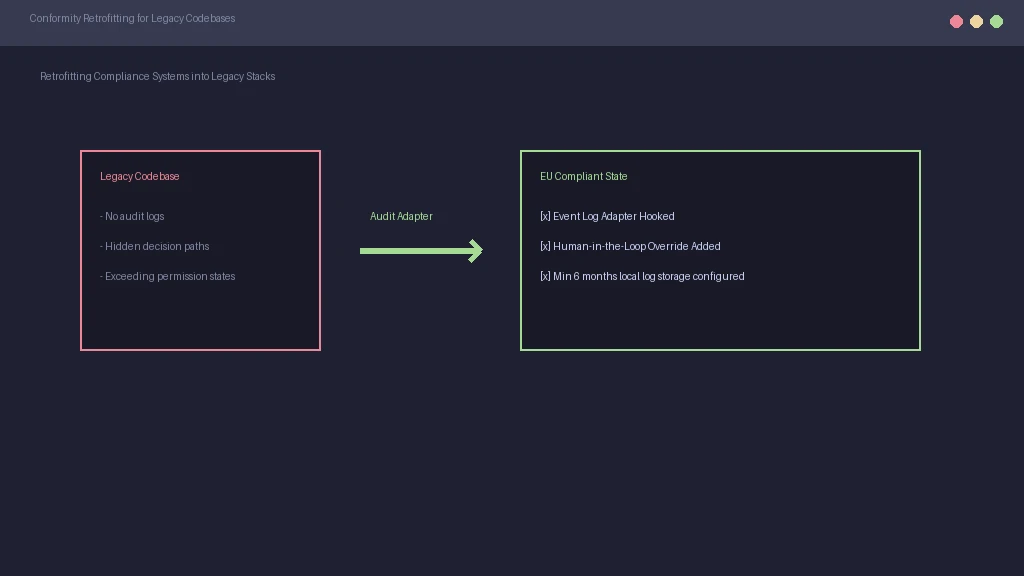
Many legacy systems lack the logging systems required for high-risk audits. Developers must write adapters to capture model inputs and outputs. You must preserve these logs for a minimum of six months. Integrating these trackers into legacy architectures requires careful testing.
Changing a model's weights, fine-tuning on new data, or altering system permissions counts as a significant modification. These actions trigger a new conformity assessment. Teams should review their update schedule before August 2, 2026.
What is the high-risk AI system compliance deadline? Most high-risk AI systems must comply with the EU AI Act starting August 2, 2026. Teams must complete their conformity assessments and register before this date.
How do teams perform an EU AI Act self-assessment? Teams use official Annex III checklists to review if their software falls into high-risk areas. If classified as high-risk, you must follow the complete safety verification process.
What are the transparency requirements under Article 50? Article 50 demands that users are clearly notified when interacting with AI systems. This includes generative writing interfaces and automated customer service systems.
Are API wrappers subject to EU AI Act fines? Yes, if your API wrapper serves a high-risk sector like hiring, you are classified as the Provider. You must meet all conformity and logging obligations despite using third-party models.
Where do developer teams register high-risk AI systems? Providers must register their high-risk systems in the official EU database. This public registry requires detailed documentation on system risk mitigation and development audits.
What happens to legacy codebases that fail compliance audits? Systems that violate compliance rules must be shut down or updated immediately to avoid penalties. Launching unprepared operational models in high-risk zones carries severe financial liabilities.